Why Most Projects Fail Even When Tasks Are Completed
Cut project chaos without adding more meetings. Discover how agencies can streamline workflows, improve collaboration, and boost productivity with smarter management
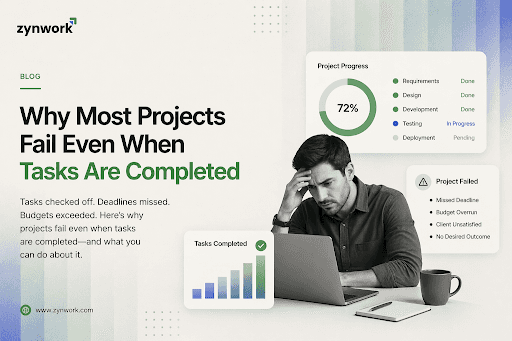
The Completion Paradox Most Teams Ignore
In many organizations, project dashboards look deceptively positive. Tasks are marked complete, timelines appear structured, and teams seem fully engaged. On the surface, everything signals progress.
Yet, when the project reaches its conclusion, the reality often tells a different story:
Deadlines slip. Budgets stretch. Outcomes fall short.
This raises an important question:
How can a project fail when all the tasks are completed?
The answer lies in a fundamental misunderstanding of what “progress” actually means.
The Illusion of Progress
Task completion creates a powerful sense of momentum. Each checked box reinforces the belief that the project is moving forward as planned. But this perception can be misleading.
Completing tasks does not necessarily mean the project is closer to its intended outcome. It only indicates that predefined activities have been executed.
Across multiple delivery environments, teams often rely heavily on task management systems. While these tools improve coordination, they do not ensure that work aligns with the final objective.
This gap between activity and outcome is where projects begin to drift.
Execution vs Delivery: A Critical Distinction
Execution is about completing tasks.
Delivery is about achieving outcomes.
Most teams are optimized for execution:
Assign work
Track progress
Move tasks to “done”
But delivery requires:
Understanding dependencies
Aligning work to outcomes
Maintaining direction toward business goals
A project can be executed perfectly on paper and still fail in reality.
Real Example
A team completed 92% of sprint tasks, yet missed the release deadline by 3 weeks.
Why?
A critical dependency was delayed
No visibility into cross-team impact
Tasks were completed, but delivery flow was broken
Why Projects Fail Even When Work Gets Done
Misaligned Goals
Tasks are completed, but not aligned with outcomes.
Lack of Real-Time Visibility
Issues are discovered too late.
Poor Dependency Management
Work is completed out of sequence, breaking flow.
Absence of Delivery Metrics
Teams track activity, not impact.
Ignoring Financial Impact
Costs rise, profitability drops despite task completion.
The Hidden Cost of “Everything Done”
Missed deadlines
Increased costs
Low client satisfaction
Team burnout
How to Fix This
Map every task to a measurable outcome
Track dependencies, not just tasks
Introduce delivery metrics:
Outcome alignment %
Delay impact score
Replace status meetings with real-time visibility
Connect execution to financial impact
The Shift That Matters
From tracking activity → understanding impact
From managing tasks → managing outcomes
From isolated execution → connected delivery
Conclusion
Projects don’t fail because work isn’t done.
They fail because the wrong work is done, in the wrong sequence, without understanding its impact.
Until teams shift from tracking tasks to managing delivery, this problem will continue to repeat — no matter how advanced the tools become.