Project Management Methods and Tools in 2026
Cut project chaos without adding more meetings. Discover how agencies can streamline workflows, improve collaboration, and boost productivity with smarter management
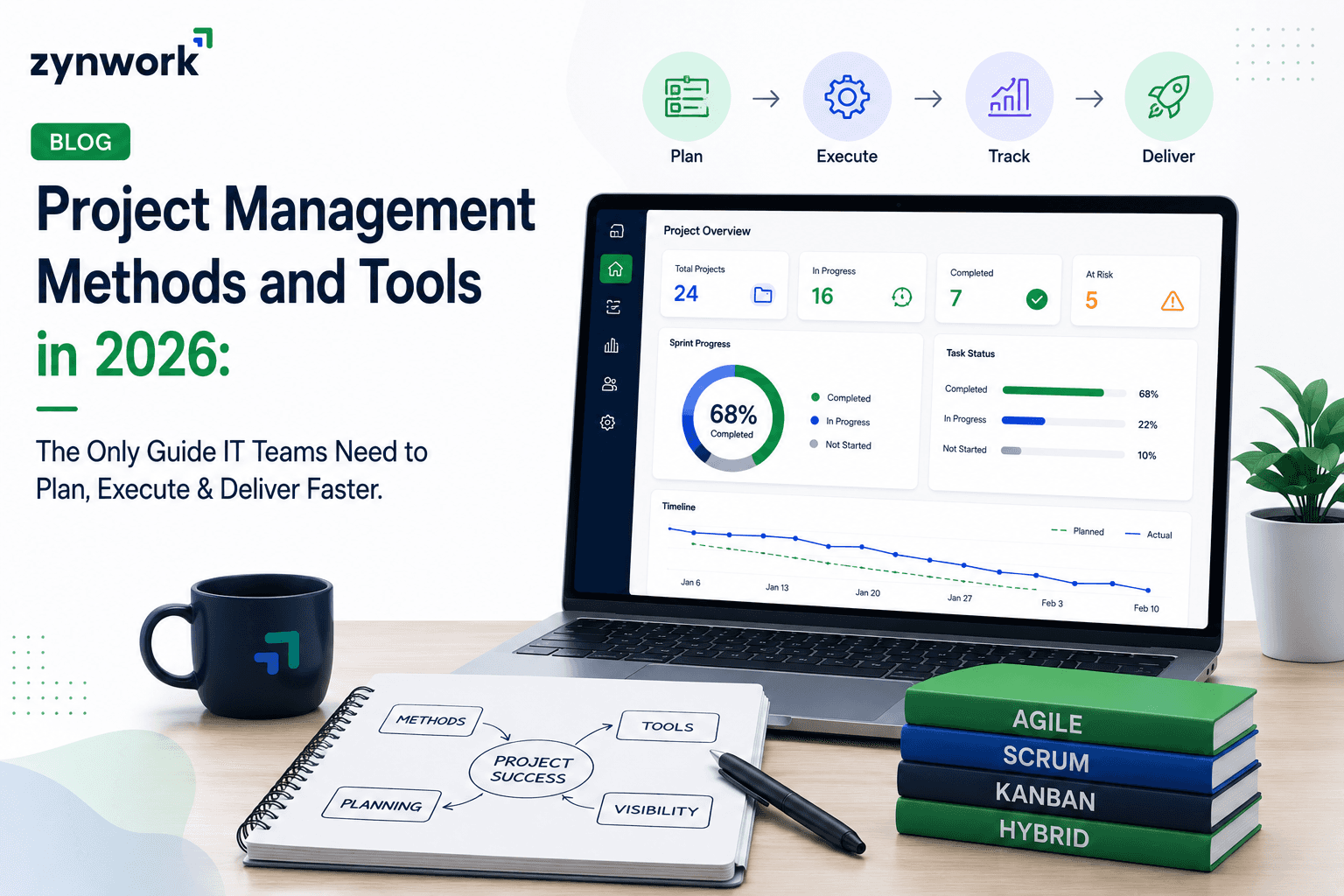
The Only Guide IT Teams Need to Plan, Execute & Deliver Faster
Most IT teams do not struggle because they lack talent. They struggle because projects become difficult to coordinate as workflows grow more complex. Teams manage sprint cycles, delivery timelines, resource planning, stakeholder communication, and operational reporting all at the same time. When visibility breaks down, delays start appearing across projects.
That is why modern organizations now focus heavily on smarter project management methods and tools instead of relying on disconnected spreadsheets and manual reporting systems.
Today, high-performing IT teams use centralized dashboards, sprint intelligence, operational visibility, and real-time reporting to improve execution and maintain delivery consistency.
Platforms like Zynwork help organizations connect planning, execution, reporting, workload visibility, and operational coordination in one centralized environment.
In this guide, you will learn:
why traditional project workflows fail
which project management methods work best in 2026
how operational visibility improves delivery
why planning and reporting matter more than ever
how IT teams reduce delays and bottlenecks
Why Traditional Project Management No Longer Works
A few years ago, teams could manage projects using spreadsheets, emails, and weekly meetings.
That approach no longer scales.
Modern software delivery environments move much faster. Teams now handle:
agile sprint cycles
distributed collaboration
operational dependencies
continuous releases
workload balancing
stakeholder coordination
Disconnected systems create confusion because teams cannot see operational progress clearly.
This leads to:
missed deadlines
reporting delays
communication gaps
workflow bottlenecks
poor accountability
These are some of the biggest project management challenges modern IT organizations face today.
Without centralized visibility, leadership teams struggle to make fast operational decisions.
What Are Project Management Methods?
Project management methods are structured systems organizations use to:
plan workflows
coordinate teams
manage execution
track deliverables
reduce risks
improve operational visibility
Different organizations use different approaches depending on project complexity and delivery requirements.
The goal remains the same:
improve delivery efficiency while maintaining operational control.
The Most Popular Project Management Methods in 2026
Modern organizations usually combine multiple workflows instead of depending on a single rigid framework.
Here are the most widely used approaches.
Agile Project Management
Agile remains one of the most common software delivery methods.
Agile focuses on:
sprint execution
iterative workflows
adaptive planning
continuous improvement
faster releases
This helps teams respond quickly to changing priorities.
Agile also improves collaboration between development, QA, operations, and leadership teams.
Scrum Framework
Scrum organizes work into short sprint cycles.
Teams manage:
sprint planning
backlog prioritization
sprint reviews
daily standups
workflow coordination
Scrum improves operational visibility and helps teams maintain delivery consistency.
Modern sprint management systems strengthen this process by improving real-time tracking across workflows.
Kanban Workflow Management
Kanban focuses heavily on visual task management.
Teams use workflow boards to track:
task progress
bottlenecks
delivery stages
workload visibility
This helps organizations improve operational coordination and reduce delays.
Why Modern IT Teams Need Better Tools
Methods alone are not enough anymore.
Organizations also need connected systems that improve:
operational visibility
sprint tracking
workload management
reporting automation
workflow coordination
Modern project management methods and tools work best when they operate inside centralized environments.
Disconnected tools create operational silos that reduce efficiency.
Connected systems improve visibility across projects and departments.
The Importance of Planning in Software Delivery
Strong planning is one of the biggest drivers of successful project execution.
Modern activity planning in software project managemen environments focus heavily on:
workload balancing
sprint coordination
resource allocation
delivery timelines
operational forecasting
Without strong planning systems, projects become difficult to manage as complexity increases.
Operational planning helps organizations:
improve accountability
reduce bottlenecks
improve sprint visibility
strengthen workflow coordination
This improves delivery consistency across teams.
Traditional Tools vs Modern Project Platforms
Modern software delivery requires far more visibility than traditional systems can provide.
Traditional Project Tools | Modern Project Platforms |
Spreadsheet tracking | Centralized dashboards |
Delayed reporting | Real-time visibility |
Manual updates | Automated workflow tracking |
Fragmented communication | Connected collaboration |
Static planning | Adaptive operational planning |
Limited analytics | Real-time operational intelligence |
Modern platforms help organizations improve:
sprint execution
reporting accuracy
workflow visibility
delivery forecasting
more effectively.
Why Visibility Improves Delivery
Operational visibility is one of the most important factors in project success.
Without visibility, teams struggle to understand:
sprint progress
workload distribution
delivery risks
operational blockers
resource capacity
This slows decision-making and creates coordination problems.
Modern organizations increasingly use centralized dashboards and operational analytics to improve:
workflow tracking
reporting visibility
delivery coordination
sprint intelligence
This allows teams to identify problems earlier and respond faster.
Common Project Management Challenges IT Teams Face
As software delivery grows more complex, organizations face increasing operational pressure.
Some of the most common project management challenges include:
unclear ownership
delayed approvals
communication gaps
uneven workloads
sprint bottlenecks
fragmented reporting
These problems usually appear when operational visibility is weak.
High-performing teams reduce these issues through:
centralized reporting
connected workflows
sprint intelligence
workload visibility
operational analytics
This improves execution consistency significantly.
Why Real-Time Reporting Matters
Traditional reporting cycles are too slow for modern IT environments.
High-performing organizations now rely on:
live dashboards
automated reporting
operational alerts
sprint monitoring
workflow analytics
to improve decision-making.
Real-time visibility helps organizations:
identify delays earlier
improve accountability
reduce operational risks
improve delivery forecasting
This strengthens project execution across teams.
How Workload Visibility Improves Team Efficiency
Many project delays happen because workloads become unbalanced across teams.
Overloaded employees often experience:
burnout
reduced focus
slower execution
workflow delays
Strong visibility helps organizations distribute work more effectively.
Modern systems improve:
resource planning
sprint forecasting
workload allocation
operational coordination
through centralized analytics and reporting.
This improves long-term delivery stability.
How Modern Platforms Improve Project Execution
Modern project intelligence platforms help organizations centralize:
sprint management
operational reporting
workflow coordination
workload tracking
performance visibility
delivery monitoring
This reduces fragmentation significantly.
Platforms like Zynwork help IT teams improve operational visibility by connecting sprint execution, reporting intelligence, workload management, and workflow tracking in one environment.
This improves both delivery speed and operational scalability.
The Future of Project Management in 2026
Project management continues evolving rapidly.
Organizations increasingly rely on:
AI-powered forecasting
operational analytics
automated reporting
predictive workload monitoring
centralized visibility systems
to improve software delivery.
Modern IT environments require connected operational ecosystems instead of isolated management systems.
Organizations with stronger visibility and operational coordination will maintain a major competitive advantage in the coming years.
Conclusion
Modern software delivery requires more than spreadsheets and disconnected workflows.
Organizations that improve project management methods and tools strengthen sprint execution, operational visibility, workflow coordination, and delivery consistency across projects.
As software delivery environments become more complex, organizations must improve planning systems, reporting visibility, workload coordination, and operational intelligence to maintain performance.
Modern teams that overcome major project management challenges focus heavily on centralized visibility and connected operational systems.
Strong activity planning in software project managemen environments help organizations reduce bottlenecks, improve coordination, and deliver projects more efficiently.
If your organization wants smarter planning, faster delivery, stronger visibility, and better operational control, Zynwork helps modern IT teams manage execution with greater clarity and confidence.