Team Management: How High-Performance IT Teams Run Sprints, Track Performance & Never Miss a Deadline
Cut project chaos without adding more meetings. Discover how agencies can streamline workflows, improve collaboration, and boost productivity with smarter management
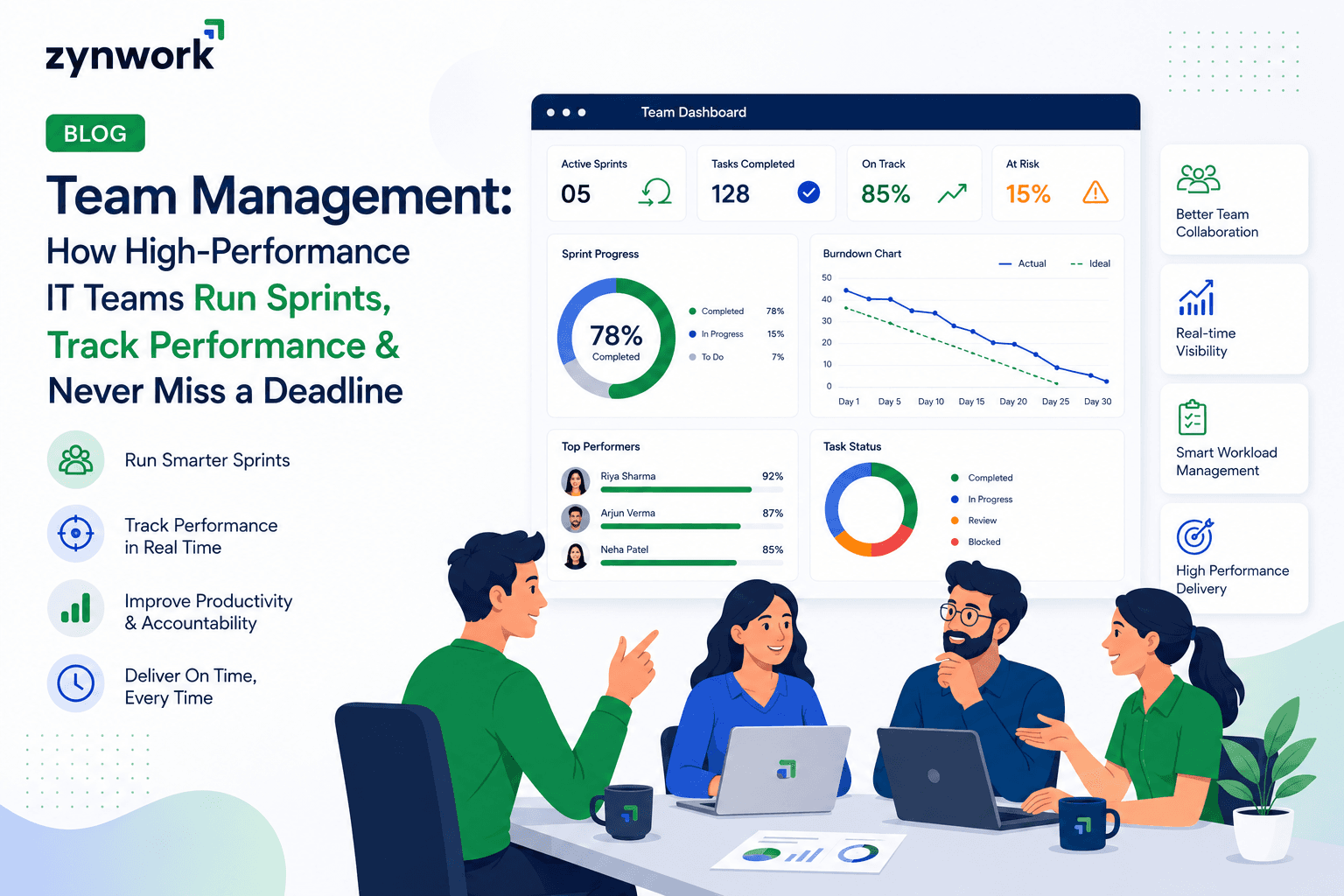
Every IT team starts with good intentions.
Deadlines look manageable, sprint goals feel realistic, and project plans seem organized. But as projects grow, communication gaps appear, priorities shift, tasks pile up, and suddenly teams start missing deadlines.
Most teams do not fail because employees lack skills. They fail because workflows, visibility, performance tracking, and coordination become difficult to manage at scale.
That is why modern IT organizations now focus heavily on smarter team management systems instead of relying on disconnected workflows and manual coordination.
Today, high-performing teams use centralized visibility, sprint coordination, performance tracking, and operational analytics to improve delivery consistency.
Platforms like Zynwork help organizations connect sprint execution, workload visibility, performance tracking, operational reporting, and project coordination in one centralized environment.
In this guide, you will learn:
why team coordination becomes difficult in modern IT environments
how high-performing teams manage sprints efficiently
why visibility improves delivery performance
how performance tracking affects deadlines
why operational intelligence matters for growing IT organizations
Why Modern IT Teams Struggle With Coordination
Software delivery has become much more complex than it was a few years ago.
Modern teams manage:
agile sprint cycles
distributed employees
multiple stakeholders
continuous deployments
workflow dependencies
changing project priorities
operational deadlines
As organizations grow, coordination becomes harder because teams often rely on:
spreadsheets
disconnected tools
manual reporting
fragmented communication
isolated workflows
This creates visibility gaps across departments.
Managers struggle to understand:
sprint progress
delivery blockers
employee performance
operational risks
Without centralized visibility, projects start slowing down even when employees continue working hard.
This is why strong team management has become essential for modern IT organizations.
What High-Performance IT Teams Do Differently
High-performing teams do not simply work harder.
They operate with:
stronger visibility
better sprint coordination
clear workload distribution
centralized operational tracking
continuous performance monitoring
These organizations reduce operational confusion by connecting workflows across departments.
Instead of waiting for weekly updates, leadership teams monitor:
sprint progress
delivery health
operational risks
workload capacity
performance trends
in real time.
This allows organizations to make faster operational decisions before delays become major delivery problems.
Why Sprint Coordination Matters More Than Ever
Modern IT delivery environments move quickly.
Agile workflows require teams to coordinate:
development cycles
sprint planning
QA testing
deployment timelines
operational dependencies
across multiple teams simultaneously.
Without strong sprint visibility, organizations struggle to manage delivery consistency.
Common sprint problems include:
delayed tasks
overloaded employees
blocked dependencies
unclear priorities
workflow bottlenecks
This is why centralized sprint coordination systems have become extremely important for modern software teams.
Organizations using connected sprint management systems improve:
sprint execution
workflow visibility
deadline consistency
operational coordination
significantly.
The Biggest Reason Teams Miss Deadlines
Most deadlines are not missed because teams stop working.
Deadlines are usually missed because organizations fail to identify operational problems early enough.
Common causes include:
poor workload visibility
delayed approvals
disconnected reporting
resource conflicts
communication gaps
unclear ownership
workflow inefficiencies
When leadership lacks operational clarity, small delays slowly become major project risks.
High-performing organizations reduce this problem by continuously monitoring operational performance across teams and workflows.
Real-time visibility helps teams identify delivery risks before deadlines become impossible to maintain.
Why Visibility Improves Team Performance
Visibility is one of the most important foundations of operational efficiency.
When teams clearly understand:
priorities
sprint goals
workload expectations
project status
delivery timelines
they collaborate more effectively.
Without visibility, employees often work in isolated environments where they cannot fully understand operational priorities across projects.
This creates:
duplicated work
missed dependencies
reporting confusion
delayed escalations
operational inefficiencies
Modern organizations increasingly use connected dashboards and operational analytics systems to improve team visibility.
This helps leadership maintain stronger delivery control across projects.
The Shift Away From Conventional Performance Tracking
Many organizations still rely on outdated conventional software management performance systems that focus heavily on static reporting instead of operational visibility.
Traditional systems often depend on:
manual evaluations
delayed reporting cycles
isolated metrics
fragmented dashboards
These methods create visibility gaps because they do not provide continuous operational insight.
Modern IT teams require dynamic visibility into:
sprint execution
workload efficiency
operational performance
workflow coordination
delivery health
Organizations moving away from conventional software management performance approaches improve operational responsiveness significantly.
Connected performance intelligence systems help leadership identify workflow problems much earlier.
Why Employee Performance Tracking Matters in IT Teams
Performance tracking is no longer just about annual reviews.
Modern IT environments require continuous operational visibility into:
team productivity
sprint contribution
workload balance
operational efficiency
delivery performance
This helps organizations improve coordination while reducing burnout and delivery risks.
High-performing organizations increasingly use centralized employee performance management software systems to monitor operational trends and improve team optimization.
These systems help leadership understand:
where bottlenecks exist
which teams are overloaded
where sprint delays occur
how workflows affect delivery consistency
This improves long-term operational planning.
How High-Performing Teams Manage Workloads Efficiently
Workload management plays a major role in delivery success.
Overloaded employees often experience:
burnout
reduced focus
slower execution
workflow delays
declining delivery quality
Strong operational visibility helps organizations distribute workloads more effectively across teams.
Modern IT organizations increasingly rely on:
workload analytics
sprint tracking systems
resource visibility tools
to improve operational balance.
Teams that manage workload visibility properly maintain stronger sprint consistency and delivery performance over time.
The Role of Operational Intelligence in Team Coordination
Operational intelligence helps organizations move from reactive management toward proactive delivery control.
Instead of waiting for problems to appear, leadership teams continuously monitor:
workflow performance
sprint health
operational bottlenecks
resource utilization
delivery risks
This allows organizations to improve:
forecasting
workload planning
sprint coordination
delivery predictability
Modern project intelligence systems help teams centralize operational visibility across multiple workflows and departments.
This is becoming increasingly important as software environments continue growing in complexity.
Why Cross-Team Visibility Improves Delivery
Software delivery rarely depends on one department alone.
Development teams depend on:
QA teams
operations
leadership approvals
product management
stakeholder coordination
Without shared visibility, communication gaps increase rapidly.
Cross-functional visibility helps organizations:
reduce workflow delays
improve collaboration
improve dependency tracking
strengthen operational coordination
Connected dashboards and centralized reporting systems help organizations maintain stronger visibility across departments.
This improves delivery consistency across projects.
The Importance of Real-Time Reporting
Modern delivery environments change quickly.
Static weekly reporting cycles no longer provide enough operational visibility for fast-moving software teams.
High-performing organizations increasingly rely on:
live dashboards
operational analytics
sprint tracking systems
automated reporting
real-time performance monitoring
to improve decision-making.
Real-time visibility helps leadership:
identify delays earlier
improve workload management
reduce bottlenecks
improve sprint forecasting
This strengthens delivery consistency across projects.
Why High-Performance Teams Focus on Continuous Improvement
Successful IT teams continuously improve operational workflows instead of relying on fixed systems.
They regularly analyze:
sprint performance
workflow efficiency
operational bottlenecks
workload distribution
delivery consistency
to improve long-term execution.
Organizations that continuously optimize operational coordination maintain stronger scalability as project complexity increases.
Continuous improvement also helps teams adapt more effectively to changing delivery environments.
How Modern Platforms Improve Team Coordination
Modern project intelligence platforms help organizations centralize:
sprint management
operational reporting
performance tracking
workload visibility
delivery coordination
workflow analytics
This reduces operational fragmentation significantly.
Instead of relying on disconnected systems, teams gain centralized visibility into project execution and operational performance.
Platforms like Zynwork help organizations improve delivery coordination by connecting operational visibility, sprint execution, workload management, and performance tracking in one environment.
This improves both delivery efficiency and long-term operational scalability.
Common Mistakes IT Teams Should Avoid
Even experienced organizations sometimes struggle with operational coordination.
Here are some common mistakes teams should avoid.
Relying Too Heavily on Manual Reporting
Manual reporting slows operational visibility and creates inconsistencies.
Automated dashboards improve coordination significantly.
Ignoring Workload Balance
Overloaded employees reduce delivery efficiency and increase burnout risks.
Organizations should continuously monitor workload distribution.
Delayed Performance Visibility
Delayed operational insights reduce leadership responsiveness.
Real-time reporting improves delivery control.
Fragmented Communication Systems
Disconnected communication creates workflow confusion across departments.
Centralized operational visibility improves collaboration significantly.
Using Isolated Tracking Systems
Disconnected systems reduce overall operational clarity.
Organizations should connect workflows, reporting, sprint tracking, and performance visibility into centralized systems.
The Future of Team Coordination in IT
Modern IT environments are becoming more operationally connected and data-driven.
Organizations increasingly use:
AI-powered analytics
predictive workload monitoring
automated sprint intelligence
operational forecasting
centralized dashboards
to improve delivery coordination.
As software delivery environments continue evolving, operational visibility will become even more important for maintaining delivery speed, scalability, and consistency.
Organizations that improve workflow visibility and operational intelligence will maintain a major competitive advantage in future software delivery environments.zynwork
Final Thoughts
Modern software delivery requires more than basic coordination.
Organizations that improve team management strengthen sprint execution, workload visibility, delivery consistency, and operational efficiency across projects.
High-performing teams succeed because they continuously monitor workflows, operational performance, sprint health, and delivery risks in real time.
As organizations move away from outdated conventional software management performance systems, centralized operational visibility becomes increasingly important for maintaining delivery control.
Modern employee performance management software platforms help IT organizations improve workflow coordination, optimize workloads, strengthen reporting visibility, and improve long-term delivery performance.
If your organization wants stronger sprint visibility, smarter workload coordination, connected operational intelligence, and better delivery consistency, Zynwork helps modern IT teams manage performance, workflows, and project execution with greater clarity and control.