What Is Project Delivery Management? A Complete Guide
Cut project chaos without adding more meetings. Discover how agencies can streamline workflows, improve collaboration, and boost productivity with smarter management
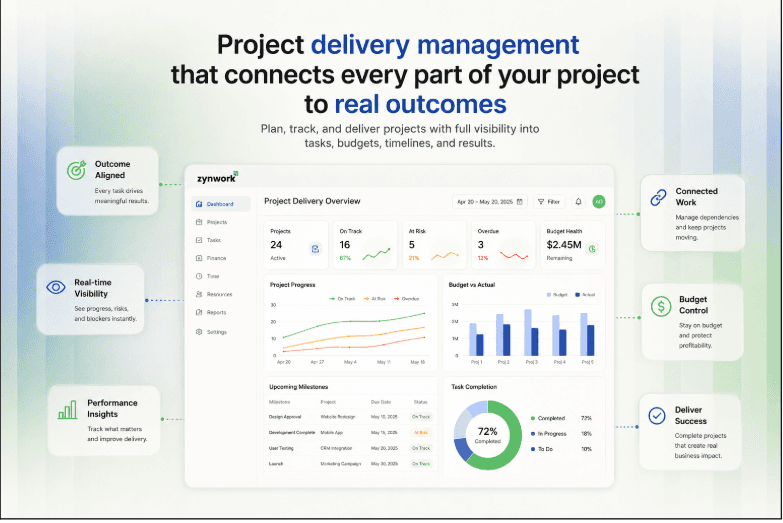
Project delivery management is one of the most critical yet overlooked aspects of modern project success.
In many teams, projects appear successful on paper. Tasks are completed, timelines are followed, and workflows are executed as planned.
Yet, the final outcome often tells a different story.
Deadlines slip. Budgets increase. Expected results aren’t achieved.
If this sounds familiar, it’s not an execution problem it’s a delivery problem. As explained in our guide on why projects fail even when tasks are completed, finishing work doesn’t always translate into success.
Quick Definition: Project Delivery Management
Project delivery management is the process of ensuring that all project activities lead to successful outcomes, not just completed tasks.
It focuses on aligning execution with:
Business goals
Timelines
Budgets
Measurable results
What Is Project Delivery Management?
Project delivery management ensures that every part of a project contributes to meaningful outcomes.
It involves:
Aligning tasks with business objectives
Tracking progress beyond task completion
Managing risks and dependencies
Ensuring projects deliver expected value
Execution creates activity.
Delivery creates results.
Project Execution vs Delivery (Quick Recap)
To understand delivery management, it’s important to distinguish it from execution.
Project Execution = completing tasks and activities
Project Delivery = achieving outcomes and results
Most teams are optimized for execution. However, as explored in project execution vs delivery, execution alone does not guarantee success.
Why Project Delivery Management Matters
Without a delivery-focused approach, teams often face:
Projects that are completed but ineffective
Missed deadlines despite high activity
Budget overruns
Misalignment between teams and business goals
As discussed in why projects fail even when tasks are completed, these issues are often not due to lack of effort but lack of delivery focus.
Core Components of Project Delivery Management
1. Outcome Alignment
Every task should contribute to a clear objective.
2. Real-Time Visibility
Teams need clarity on progress, risks, and bottlenecks.
3. Dependency Management
Ensures tasks are completed in the right sequence.
4. Delivery Metrics
Focus on outcomes, not just activity.
5. Financial Tracking
Ensures projects remain profitable and sustainable.
Key Metrics for Measuring Project Delivery
Timeline Accuracy
Outcome Success Rate
Budget Variance
Resource Efficiency
Using project performance analytics, teams can better understand delivery performance.
Common Mistakes Teams Make
Focusing Only on Execution
Teams confuse activity with progress.
Lack of Visibility
Leads to reactive decisions and delays.
Over-Reliance on Tools
As explained in task management software for corporates and IT companies, tools alone don’t guarantee success.
Ignoring Outcomes
Focusing only on project management deliverables instead of results.
Trying to Fix Problems with More Meetings
As discussed in cutting project chaos without adding more meetings, communication alone doesn’t solve structural issues.
Project Delivery vs Traditional Project Management
Aspect | Traditional | Delivery-Focused |
Focus | Tasks | Outcomes |
Measurement | Activity | Results |
Visibility | Limited | End-to-end |
How to Improve Project Delivery
Align tasks with outcomes
Improve visibility
Use integrated systems
Track delivery metrics
Use performance management tools effectively
The Role of Tools in Project Delivery
Tools support delivery but don’t define it.
Even with advanced systems, success depends on how well teams connect execution with outcomes.
The Future of Project Delivery Management
Project delivery is evolving through:
AI-driven insights
Real-time analytics
Unified platforms
These changes will help teams shift from reactive execution to proactive delivery.
FAQs
What is project delivery management?
It is the process of ensuring projects achieve outcomes, not just complete tasks.
Why is project delivery management important?
Because completing tasks alone does not guarantee success only outcomes do.
What is the difference between execution and delivery?
Execution focuses on tasks, while delivery focuses on results.
How can teams improve project delivery?
By aligning work with goals, improving visibility, and tracking the right metrics.
Conclusion
Most teams don’t fail because they don’t work hard.
They fail because they measure the wrong things.
Project execution ensures work gets done.
Project delivery ensures the work matters.
To go deeper, explore why projects fail even when tasks are completed and understand the gap in project execution vs delivery.
Because success is not defined by activity but by outcomes.